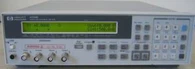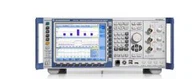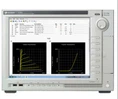

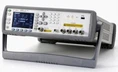

A spectrum analyzer measures the magnitude of an input signal versus frequency within the full frequency range of the instrument. The primary use is to measure the power of the spectrum of known and unknown signals. The input signal that most common spectrum analyzers measure is electrical; however, spectral compositions of other signals, such as acoustic pressure waves and optical light waves, can be considered through the use of an appropriate transducer. Spectrum analyzers for other types of signals also exist, such as optical spectrum analyzers which use direct optical techniques such as a monochromator to make measurements.
By analyzing the spectra of electrical signals, dominant frequency, power, distortion, harmonics, bandwidth, and other spectral components of a signal can be observed that are not easily detectable in time domain waveforms. These parameters are useful in the characterization of electronic devices, such as wireless transmitters.
The display of a spectrum analyzer has frequency on the horizontal axis and the amplitude displayed on the vertical axis. To the casual observer, a spectrum analyzer looks like an oscilloscope and, in fact, some lab instruments can function either as an oscilloscope or a spectrum analyzer.
Spectrum analyzer types are distinguished by the methods used to obtain the spectrum of a signal. There are swept-tuned and fast Fourier transform (FFT) based spectrum analyzers:
●A swept-tuned analyzer uses a superheterodyne receiver to down-convert a portion of the input signal spectrum to the center frequency of a narrow band-pass filter, whose instantaneous output power is recorded or displayed as a function of time. By sweeping the receiver's center-frequency (using a voltage-controlled oscillator) through a range of frequencies, the output is also a function of frequency. But while the sweep centers on any particular frequency, it may be missing short-duration events at other frequencies.
●An FFT analyzer computes a time-sequence of periodograms. FFT refers to a particular mathematical algorithm used in the process. This is commonly used in conjunction with a receiver and analog-to-digital converter. As above, the receiver reduces the center-frequency of a portion of the input signal spectrum, but the portion is not swept. The purpose of the receiver is to reduce the sampling rate that the analyzer must contend with. With a sufficiently low sample-rate, FFT analyzers can process all the samples (100% duty-cycle), and are therefore able to avoid missing short-duration events.
Hot Tags: basic spectrum analyzer, China, manufacturers, Suppliers, Factory, buy, low price, in stock, Oscilloscopes, Bit Error Ratio Testers, SourceMeter, Dynamic And FFT Analyzers, Digital Multimeter, 4 Channels High Resistance Meter